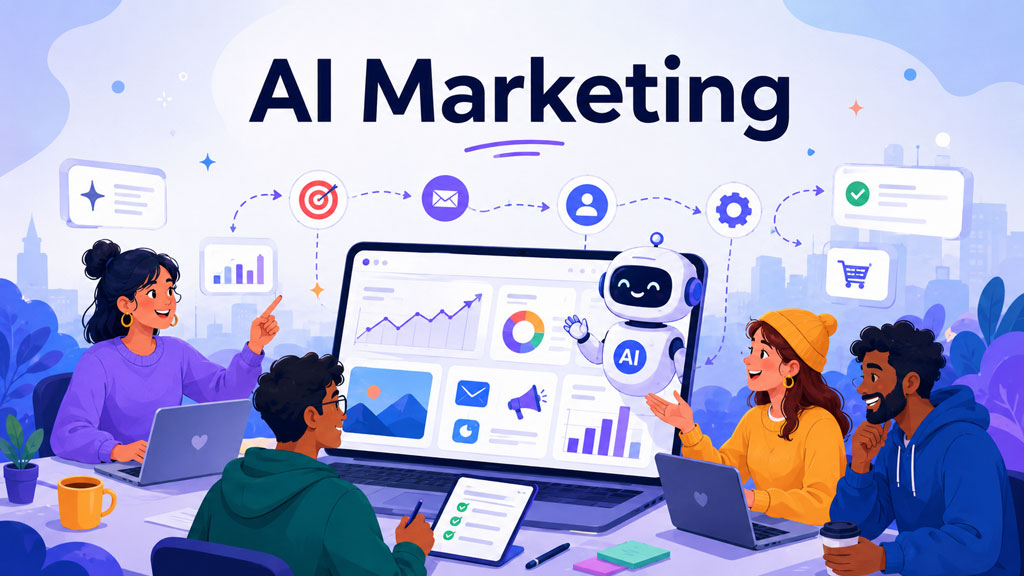
AI can write copy, analyse data, organise information, suggest campaign ideas, generate imagery, assist with videos, identify patterns, and perform an ever-growing collection of other marketing tasks.
Fantastic.
Should we all pack up and go home?
Not quite.
The real opportunity with AI marketing automation isn’t creating marketing without humans. It’s helping humans spend less time doing repetitive work and more time doing the thinking that actually moves businesses forward.
What Is AI Marketing Automation?
Traditional marketing automation follows predefined rules.
For example:
Someone completes a form. An automated email is sent.
AI adds another layer by analysing information, recognising patterns, generating content, making recommendations, or assisting with decisions.
Depending on the technology involved, AI marketing tools can help with areas such as:
- Audience segmentation
- Advertising optimisation
- Research
- Content ideation
- Data analysis
- Reporting
- Personalisation
- Customer interactions
- Campaign workflows
- Creative production
The important word here is help.
AI is a tool, not a marketing strategy.
Where Can AI Save Marketers Time?
There are plenty of marketing jobs that are necessary but spectacularly unglamorous.
Nobody became a marketer because they dreamed of spending Friday afternoon manually reorganising a giant spreadsheet.
This is where AI marketing automation gets interesting.
Research and Analysis
AI can help marketers sift through large amounts of information, identify patterns, group data, and surface useful insights much faster.
Humans can then decide what those insights actually mean.
Campaign Optimisation
Advertising platforms increasingly use machine learning and automation to make decisions around audiences, placements, bidding, and performance.
That can reduce manual workload, although human oversight still matters.
Content Planning
AI can help brainstorm topics, identify content gaps, structure information, generate starting points, and turn one larger idea into multiple possible formats.
Notice we said starting points.
More on that shortly.
Reporting
Instead of drowning in numbers, marketers can use intelligent tools to help organise results and identify useful trends.
The real value isn’t having more data.
It’s knowing what to do with it.
Where Humans Still Win
AI is astonishingly good at certain tasks.
It is also capable of producing something that is technically correct, beautifully structured, grammatically spotless… and approximately as exciting as an instruction manual for a beige filing cabinet.
Human marketers bring context.
We understand why something is funny. We recognise cultural references. We can challenge a weak idea. We know when a message feels wrong for a brand, even if every sentence is technically fine.
Humans bring:
- Creativity
- Experience
- Empathy
- Humour
- Judgement
- Cultural understanding
- Strategic thinking
- Brand personality
These are not inconvenient extras.
They’re the bits that make marketing connect.
Beware the Great AI Content Beige-ification
The easier content becomes to produce, the easier it becomes to produce lots of very average content.
You’ve probably seen it already.
Perfectly polished paragraphs that say a lot without really saying anything.
Posts with the same structure.
The same buzzwords.
The same suspiciously enthusiastic conclusion about “embracing the future”.
If every business asks similar AI tools to create similar content from similar prompts, everything starts to sound rather similar.
And that’s precisely why originality becomes more valuable.
Use AI to remove unnecessary effort, but don’t automate away your personality.
Your weirdness is an asset.
Within reason.
AI + Humans Is the Interesting Combination
The smartest approach to AI marketing automation is not “machine versus human”.
It’s machine plus human.
Let AI organise information.
Let humans interpret it.
Let AI generate possibilities.
Let humans choose the good ones.
Let automation handle repetitive processes.
Let marketers spend more time understanding customers, developing strategy, producing genuinely original creative work, and making decisions.
That’s where things become interesting.
Don’t Automate a Bad Strategy
There’s one rather awkward thing AI can’t magically solve:
Bad marketing.
If your positioning is unclear, your website is confusing, your advertising offer is weak, or your content doesn’t understand the audience, automating everything simply allows you to make the same mistakes faster.
Congratulations?
Before piling on more technology, get the basics right.
- Who are you talking to?
- What problem are you solving?
- Why should they care?
- What do you want them to do next?
Good tools make a good strategy more efficient. They don’t eliminate the need for one.
Put Smarter Tools Behind Smarter Marketing
AI isn’t going away, and that’s a good thing.
Used thoughtfully, AI marketing automation can help businesses work faster, analyse information more effectively, and reduce repetitive marketing tasks.
But brands still need people with ideas.
Ipcoweb Digital believes technology works best when it’s backed by creativity, strategy, content, SEO, development, and people who understand what businesses are actually trying to achieve.
Use the robots for the boring bits.
We’ll keep the humans involved in the clever stuff.
FAQs About AI Marketing Automation
What is AI marketing automation?
AI marketing automation uses artificial intelligence and automated systems to assist with activities such as analysis, content workflows, audience segmentation, campaign optimisation, reporting, and personalisation.
Will AI replace digital marketers?
AI can automate parts of marketing workflows, but strategy, creativity, judgement, brand understanding, and human oversight remain extremely important.
Can small businesses use AI marketing tools?
Yes. Businesses of different sizes can use AI tools for research, analysis, content planning, customer communication, and other tasks, depending on their needs and resources.
Should AI create all my marketing content?
It can assist, but relying entirely on automated content risks making your communication generic. Human review, original thinking, expertise, and a distinctive brand voice remain valuable.