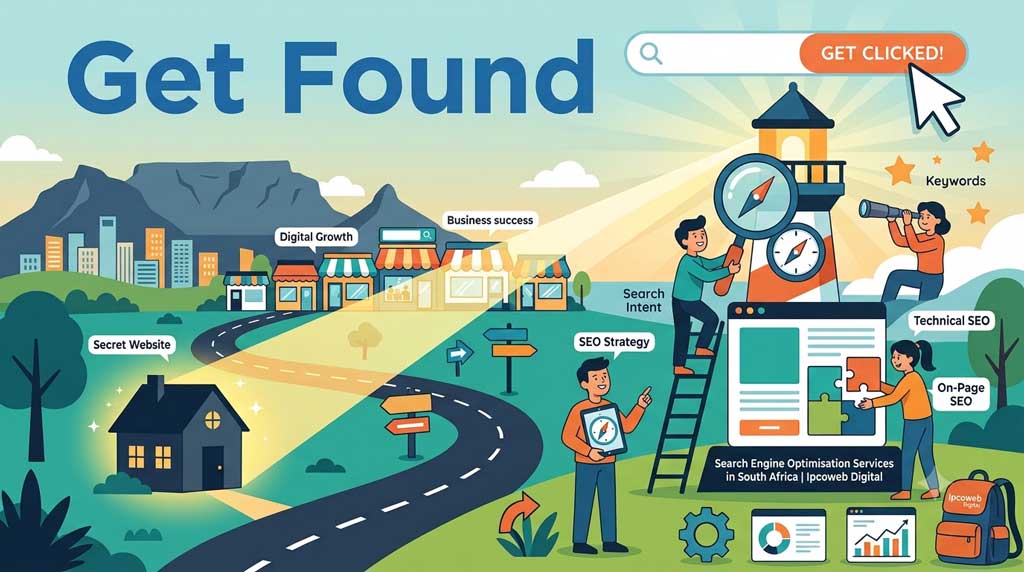
Picture this: you have a brilliant business, a polished website, competitive services, and a team ready to help customers. There is just one small problem. When people search online for exactly what you offer, your competitors appear first.
It is the digital equivalent of opening a fantastic shop at the end of a road with no signs, no directions, and a particularly unhelpful GPS.
This is where search engine optimisation, better known as SEO, enters the picture.
Professional search engine optimisation services in South Africa help businesses improve how their websites appear in organic search results. SEO makes it easier for search engines to understand your pages, and, more importantly, helps the right people find useful information when they need it.
Ipcoweb Digital doesn’t approach SEO as a bag of mysterious tricks or a once-off technical exercise. It is a long-term digital marketing process that brings together website performance, keyword research, content creation, technical improvements, user experience, analytics, and ongoing optimisation.
The goal is not simply to chase clicks. It is to attract relevant visitors who are genuinely interested in your products or services and guide them towards becoming customers.
What Is Search Engine Optimisation?
Search engine optimisation is the process of improving a website so that it has a better chance of appearing prominently when people search for relevant information, products, or services.
Imagine a potential customer typing a phrase such as:
- Plumber near me
- Corporate catering in Johannesburg
- Solar installation services in Pretoria
- Online clothing store South Africa
- Accounting services for small businesses
- Website development company in Gauteng
The search engine must decide which pages are most relevant, helpful, trustworthy, and easy to use. SEO helps ensure that your website sends the right signals.
These signals can include:
- Relevant, well-written content
- Clear page titles and headings
- Logical website navigation
- Mobile-friendly design
- Fast page-loading times
- Secure website connections
- Helpful internal links
- Accurate business information
- Quality backlinks
- A strong user experience
No single element carries an SEO strategy. Sustainable results usually come from many sensible improvements working together over time.
Why SEO Matters to South African Businesses
South Africans routinely use search engines to compare products, research services, find nearby businesses, check opening hours, read reviews, and decide who to contact.
This means your website may be competing for attention before a potential customer has even heard your company name.
A strong presence in organic search can help you reach people at several stages of their decision-making journey. Some visitors may be gathering information, while others may be ready to request a quote, book an appointment, make a telephone call, or complete a purchase.
Effective search engine optimisation services in South Africa can support businesses that serve:
- Individual suburbs or towns
- Larger municipal areas
- Specific provinces
- Customers throughout South Africa
- Regional African markets
- International audiences
The right strategy depends on where your customers are located and how they search.
A Johannesburg business targeting nearby clients will have different priorities from a South African e-commerce store shipping nationwide. An industrial supplier may focus on highly specific technical searches, while a consumer brand may need broader product guides, comparisons, and lifestyle content.
There is no universal list of keywords that works for everyone. SEO must reflect the real business behind the website.
SEO Begins with Understanding Search Intent
Keywords are important, but modern SEO is not simply about repeating a phrase as many times as possible.
Search engines are trying to understand intent: what the person actually wants to achieve.
Someone searching for “what is solar panel maintenance?” is probably looking for information. A person searching for “solar panel maintenance company near me” may be much closer to making an enquiry.
Search intent is commonly divided into several broad categories.
Informational Intent
The person wants to learn something or find an answer.
Examples include:
- How does SEO work?
- Why is my website slow?
- What is responsive web design?
Commercial Intent
The user is comparing services, brands, or solutions before making a decision.
Examples include:
- Best SEO agency for small businesses
- SEO versus Google Ads
- Website development packages South Africa
Transactional Intent
The person is ready to take action, such as buying, booking, subscribing, or requesting a quotation.
Examples include:
- Hire an SEO company
- Request a digital marketing quote
- Buy safety equipment online
Navigational Intent
The person is searching for a particular company, website, or page.
Understanding these differences helps us match each page with the right audience and purpose. A useful guide should not be written like a sales page, and a service page should not make customers dig through a lengthy history lesson before finding out how to contact the company.
Keyword Research: Finding the Language Customers Use
Business owners know their industries well, but customers do not always use the same terminology.
A company may describe a service using a formal technical name, while its customers use a shorter, more familiar phrase. Keyword research helps identify this difference.
Our research process considers factors such as:
- The products and services offered
- The locations being targeted
- Relevant search phrases
- Customer questions
- Search intent
- Related topics
- Competitor positioning
- Long-tail keywords
- Existing website performance
- Opportunities for new pages or articles
Long-tail keywords are particularly useful for many South African businesses. These are longer, more specific phrases that may attract fewer searches individually but often reveal clearer intent.
For example, “shoes” is an extremely broad search. “Women’s trail-running shoes in South Africa” is much more specific and is likely to attract a visitor with a clearer idea of what they need.
Good keyword research does not merely identify popular phrases. It finds realistic opportunities that connect search behaviour with business goals.
On-Page SEO: Helping Every Page Do Its Job
On-page SEO covers the elements we can optimise directly on a website.
Each page should have a clear purpose. A visitor and a search engine should both be able to understand what the page is about without playing detective.
Page Titles
The page title helps communicate the main subject of the page and may appear as the clickable heading in search results.
It should be specific, relevant, and appealing without relying on exaggerated claims.
Meta Descriptions
A meta description summarises the page and can encourage searchers to click through.
Although it is not a miniature billboard for stuffing in every keyword imaginable, it should clearly explain what the visitor can expect.
Headings and Subheadings
Headings organise content into manageable sections. They improve readability and help search engines understand the relationship between topics.
Page Content
Content should answer real questions, explain the service thoroughly, and help visitors decide what to do next.
Thin, vague, or duplicated copy gives both users and search engines very little reason to value a page.
Internal Links
Internal links connect relevant pages across a website.
For example, an article discussing website speed could link to website development, hosting, SEO, or maintenance services. This helps visitors discover useful information and enables search engines to explore the site more effectively.
Images
Images should be relevant, properly sized, and supported by descriptive file names and alternative text where appropriate.
Large, uncompressed images may look magnificent while loading at the approximate speed of a sleepy tortoise. Optimisation keeps the visuals without unnecessarily slowing down the page.
Technical SEO: What Happens Behind the Scenes
Technical SEO focuses on the foundation of the website.
A site may contain excellent content, but search engines can struggle to process it if the technical structure is confusing, slow, insecure, or filled with broken links.
Our technical reviews may consider:
- Website crawlability
- Search engine indexing
- Mobile responsiveness
- Page speed
- Core website performance
- Secure HTTPS connections
- URL structures
- XML sitemaps
- Redirects
- Broken pages
- Duplicate content
- Canonical tags
- Structured data
- Website architecture
Technical SEO can sound intimidating, but its purpose is straightforward: remove barriers.
Search engines should be able to access and understand the website, while visitors should be able to use it without unnecessary delays or errors.
Ipcoweb Digital’ experience in both website development and SEO allows us to consider the connection between the build of a website and its search performance. We can audit and optimise existing websites, while also creating new websites with search readiness, mobile use, and user experience in mind.
Content Creation: Giving Search Engines Something Worth Finding
A website cannot rank meaningfully for subjects it never discusses.
This is why content creation is such an important part of search engine optimisation services in South Africa.
Useful content creates more opportunities to answer customer questions and demonstrate real expertise. It can also support service pages by covering related subjects in greater depth.
An SEO content strategy may include:
- Service pages
- Product or category descriptions
- Location pages
- Educational articles
- Frequently asked questions
- How-to guides
- Industry explanations
- Buying guides
- Comparisons
- Case studies
- News and company updates
Quality matters more than publishing content for the sake of filling a calendar.
Every article should have a reason to exist. It should answer a recognisable question, address a customer concern, explain a complex topic, or help someone make a more informed decision.
We combine SEO thinking with content creation so that copy remains readable and persuasive while supporting relevant search goals. We write for people first, because content that frustrates human readers is unlikely to produce worthwhile business results.
Local SEO: Being Visible in the Right Places
Many businesses do not need to reach everyone on the internet. They need to reach the right people in the areas they serve.
Local SEO helps businesses improve their visibility for searches linked to particular towns, cities, suburbs, or regions.
A local strategy may involve:
- Optimising location-based website pages
- Maintaining accurate business details
- Strengthening Google Business Profile information
- Collecting genuine customer reviews
- Publishing locally relevant content
- Using consistent contact information
- Targeting appropriate regional keywords
- Creating clear directions or service-area information
A company serving Randburg, Sandton, Midrand, and Pretoria should make those service areas clear rather than leaving visitors to guess.
However, local SEO should remain useful and natural. Creating dozens of nearly identical pages with only the suburb name changed rarely delivers a good customer experience.
Each location page should offer meaningful information about the services available in that area.
Off-Page SEO: Reputation Beyond Your Website
Off-page SEO refers to signals that originate outside your own website.
Backlinks are among the best-known examples. A backlink is created when another website links to one of your pages.
Quality matters far more than quantity. A relevant link from a respected industry publication, supplier, business association, or news platform may be more valuable than hundreds of links from unrelated or questionable sites.
Off-page visibility can also be supported by:
- Digital public relations
- Business directory listings
- Partner or supplier profiles
- Industry publications
- Relevant guest contributions
- Brand mentions
- Social sharing
- Customer reviews
- Useful original resources
We favour sustainable reputation-building over shortcuts.
Buying poor-quality links or participating in manipulative schemes may create risk rather than long-term value. Trust takes time to build, but it is considerably harder to repair once damaged.
Website Speed and Mobile Experience Matter
Search visibility does not end when someone clicks on your result.
The website must still provide a usable experience.
A slow-loading page can lose visitors before they read the first sentence. A site that works beautifully on a desktop but becomes awkward on a smartphone can make enquiries and purchases unnecessarily difficult.
Performance improvements may involve:
- Compressing images
- Reducing unnecessary scripts
- Improving hosting
- Reviewing plugins
- Applying caching
- Simplifying page layouts
- Fixing technical errors
- Testing mobile navigation
- Improving forms and buttons
South African users browse on a wide range of devices and internet connections. Building efficient pages helps make the website accessible to more of the intended audience while supporting overall search performance.
SEO and Google Ads: Rivals or Teammates?
SEO and Google Ads are sometimes treated as competitors, but they can work particularly well together.
SEO focuses on building long-term organic visibility. Google Ads can provide immediate paid exposure for selected keywords, products, services, and locations.
Used together, they can help a business:
- Generate visibility while organic rankings develop
- Test keyword and advertising messages
- Reach high-intent audiences quickly
- Gather useful conversion data
- occupy more space on search results pages
- Support seasonal campaigns
- Retarget previous website visitors
Our wider digital marketing capabilities allow us to consider SEO, paid search, content, website performance, and conversion strategy as connected parts of the same customer journey.
The correct balance depends on the business’s goals, market, timeframe, and budget.
Measuring What Matters
SEO should be measured, but not every number deserves equal attention.
A dramatic rise in traffic may look exciting, but it means little if the visitors are irrelevant or leave immediately.
Useful SEO measurements can include:
- Organic search traffic
- Search impressions
- Click-through rates
- Keyword visibility
- Landing-page performance
- Enquiry form submissions
- Telephone calls
- Online purchases
- Engagement
- New and returning visitors
- Local search actions
- Conversion rates
Google Analytics and Google Search Console can provide valuable information about how people find and use a website.
Search Console can reveal which search queries generate impressions and clicks, while Analytics can help track what visitors do after arriving.
We use data to identify opportunities, monitor progress, and make more informed optimisation decisions. Reporting should explain what the numbers mean rather than burying clients beneath a colourful mountain of graphs.
SEO Is an Ongoing Process
One of the biggest misconceptions about SEO is that it can be completed once and then forgotten.
Search behaviour changes. Competitors improve their websites. New products launch. Content becomes outdated. Technical issues appear, and search engines continue refining how they assess and present information.
Ongoing SEO may involve:
- Monitoring website performance
- Updating existing pages
- Publishing new content
- Reviewing keyword opportunities
- Resolving technical issues
- Improving internal linking
- refreshing metadata
- Analysing search data
- Strengthening conversion paths
- Adapting to changes in search behaviour
This does not mean changing everything every week. Effective SEO is usually a process of consistent, evidence-based improvement.
Small gains across multiple pages can add up to meaningful long-term growth.
What SEO Can’t Honestly Promise
No trustworthy SEO provider can guarantee a permanent number-one ranking for every keyword.
Search rankings are influenced by competition, relevance, website quality, location, search intent, technical performance, and numerous factors controlled by search engines.
We believe realistic expectations are essential.
SEO can improve a website’s foundations, visibility, content quality, and ability to attract relevant traffic. It can create valuable opportunities, but results depend on the market, starting position, available resources, and consistency of the strategy.
Be cautious of claims involving:
- Guaranteed instant rankings
- Secret relationships with Google
- Thousands of links delivered overnight
- Results without access to the website
- One identical strategy for every business
- Reports focused only on impressive-looking numbers
Good SEO is not magic. It is strategy, technical skill, quality content, testing, and persistence wearing a slightly nerdy digital hat.
Choosing Search Engine Optimisation Services in South Africa
An SEO partner should understand both search technology and the commercial goals of the business.
Before appointing a provider, consider asking:
- How will you learn about our customers and services?
- Will you conduct a website audit?
- How do you approach keyword research?
- Are technical improvements included?
- Can you create or optimise content?
- How will success be measured?
- What reporting will we receive?
- Do you consider conversions as well as traffic?
- Can you support website development or maintenance?
- How does SEO fit into our wider digital marketing strategy?
Clear communication matters. Clients should understand what work is being performed, why it matters, and how it supports the agreed goals.
Ipcoweb Digital brings together SEO, content creation, website development, auditing, analytics, paid advertising, and social media marketing. This gives us a broader view of the digital journey, from the initial search to the final conversion.
Get Found with Ipcoweb Digital
Your customers are already searching. The real question is whether they are finding you or one of your competitors.
Our search engine optimisation services in South Africa are designed to help businesses build stronger search visibility through strategic keyword research, technical optimisation, helpful content, website auditing, and continuous improvement.
We look beyond rankings to consider the entire experience. That includes how visitors discover your website, what they see when they arrive, how easily they navigate the pages, and whether they are encouraged to make contact or complete a purchase.
Whether you need to strengthen an established website, improve underperforming pages, develop an ongoing content strategy, or connect SEO with Google Ads and broader digital marketing, we are ready to help.
Let us turn your website from a well-kept digital secret into a visible, useful, and hard-working part of your business. Contact Ipcoweb Digital to discuss an SEO strategy built around your audience, market, and growth goals.
FAQs About Search Engine Optimisation Services
What are search engine optimisation services?
Search engine optimisation services improve a website’s ability to appear in relevant organic search results. They may include website audits, keyword research, technical SEO, content optimisation, link strategies, local SEO, performance monitoring, and reporting.
How long does SEO take to work?
SEO is a medium- to long-term process. The timeframe depends on the website’s current condition, competition, industry, keyword difficulty, content quality, and consistency of the work. Some improvements may be visible relatively quickly, while competitive searches can take considerably longer.
How much do SEO services cost in South Africa?
Costs vary according to the size of the website, scope of work, competitiveness of the market, content requirements, and whether technical development is needed. A professional provider should assess the website and business objectives before recommending an appropriate package.
Can SEO guarantee a first-page Google ranking?
No reputable SEO provider can guarantee a particular organic ranking. Search engines control their own results, and rankings are influenced by many changing factors. SEO improves the website’s quality and competitiveness but cannot provide absolute guarantees.
What is the difference between SEO and Google Ads?
SEO aims to improve visibility in organic search results over time. Google Ads provides paid placements that can generate exposure as soon as a campaign launches. SEO supports long-term growth, while paid advertising can deliver more immediate, targeted traffic.
Do small South African businesses need SEO?
SEO can be particularly valuable for small businesses because it helps them reach people actively searching for their services. A focused local or niche strategy can allow a smaller company to compete without trying to target every possible search.
What is local SEO?
Local SEO improves visibility for searches connected to a particular area. It may include location pages, Google Business Profile optimisation, customer reviews, consistent contact details, locally relevant content, and regional keyword targeting.
Does content creation form part of SEO?
Yes. Content helps search engines understand what a website offers and gives businesses opportunities to answer customer questions. Service pages, guides, articles, FAQs, and product descriptions can all support an SEO strategy when they are accurate, original, and useful.
What is an SEO audit?
An SEO audit evaluates a website’s technical condition, content, structure, performance, metadata, links, mobile usability, and search visibility. It identifies issues that may be limiting performance and helps prioritise future improvements.
Why is keyword research important?
Keyword research reveals how potential customers search for information, services, and products. It helps businesses choose suitable topics, create relevant pages, understand search intent, and avoid relying solely on internal industry terminology.
Can Ipcoweb Digital optimise an existing website?
Yes. We can review an existing website, identify technical and content opportunities, optimise individual pages, develop a keyword strategy, and recommend ongoing improvements. Where necessary, our website development capabilities can support technical changes.
How is SEO performance measured?
SEO performance can be measured through organic traffic, search impressions, clicks, keyword visibility, enquiries, calls, sales, engagement, and conversion rates. The most useful measurements are those connected to the business’s actual objectives.
Do I need SEO every month?
Ongoing SEO is recommended for businesses operating in active or competitive markets. Regular work allows the strategy to respond to new search trends, competitor activity, technical issues, content gaps, and performance data.
Can SEO help a website appear in Google Discover?
High-quality, original, engaging content and a strong website experience may improve a site’s eligibility for Google Discover, although inclusion cannot be guaranteed. Clear expertise, compelling topics, suitable imagery, mobile usability, and trustworthy content are important considerations.
What information does an SEO agency need from my business?
An agency should understand your services, target audience, locations, competitors, priorities, previous marketing activity, and business goals. Access to relevant website and analytics platforms may also be required to evaluate performance and implement improvements.