A successful website does not begin with code. It begins with clarity.
Before a developer writes a single line, before a designer starts working on layouts, and before content is uploaded into a CMS, a website development project needs a clear plan. Without one, even a visually impressive website can become slow, confusing, difficult to update, poorly optimised for search engines or disconnected from the business goals it was meant to support.
For South African businesses, a website is often the centre of all digital activity. It supports SEO, Google Ads, social media campaigns, lead generation, online credibility, customer service, e-commerce, recruitment, brand awareness and long-term growth. Whether a customer finds you through Google, Facebook, Instagram, LinkedIn, a referral or a paid advert, they will often visit your website before deciding whether to enquire, buy, book, call or trust your business.
That is why professional web development services should never be treated as a once-off technical task. Website development should be planned as a strategic business project.
Ipcoweb Digital takes a practical, integrated approach to website development. Our service offering includes website and app development, e-commerce, domain registration, hosting, SEO, creative support, content creation, digital marketing, social media marketing, Google Ads and measurement. This means we understand that a website must do more than look good. It must work properly, load quickly, support search visibility, connect with campaigns and help turn visitors into leads.
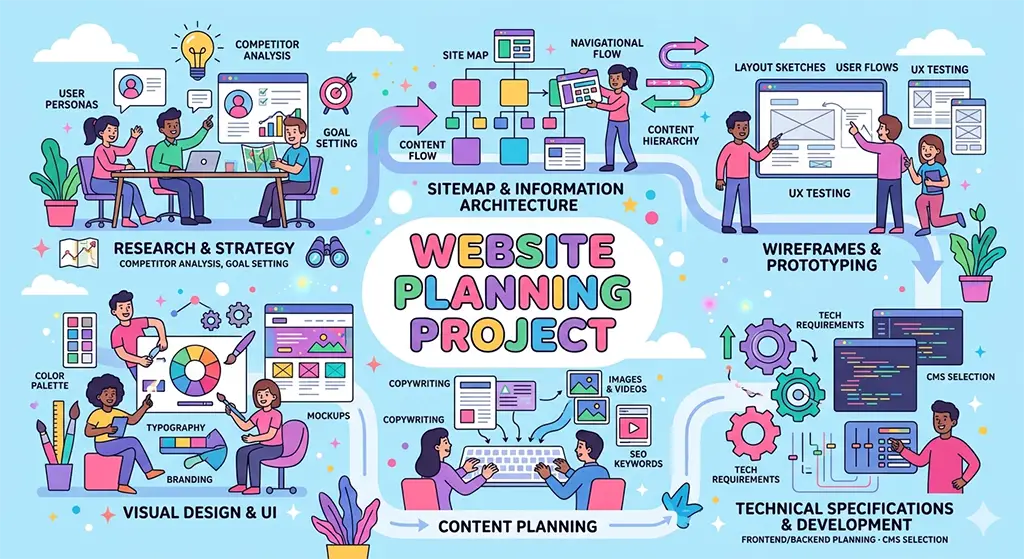
This guide explains how to plan a website development project properly, from choosing the right CMS to UX/UI design, content planning, technical structure, SEO integration, testing, launch and ongoing optimisation.
Why Website Development Planning Matters
Many website problems can be traced back to poor planning.
A business may rush into design without understanding the user journey. It may choose a CMS that does not suit its needs. It may launch with weak content, missing SEO basics, poor mobile performance or no conversion tracking. It may focus on appearance but ignore speed, navigation, technical health, security or future scalability.
These issues can become expensive to fix later.
Strong planning helps prevent:
- Unclear website objectives
- Poor user experience
- Confusing navigation
- Slow loading speeds
- Weak SEO foundations
- Content gaps
- Duplicate or thin pages
- CMS limitations
- Budget overruns
- Missed deadlines
- Poor mobile performance
- Low conversion rates
- Tracking and reporting problems
Good planning also helps everyone involved work towards the same outcome. Business owners, designers, developers, SEO specialists, content writers, marketers and decision-makers should understand what the website needs to achieve and how success will be measured.
Start with Business Objectives
The first step in any website development project is defining the purpose of the website.
A website for a law firm will not have the same goals as an e-commerce store, restaurant group, engineering company, school, medical practice, SaaS product, tourism business or industrial supplier. The structure, content, functionality, design and SEO strategy should reflect the business model.
Before starting the project, ask:
- Do we want to generate leads?
- Do we want to sell products online?
- Do we want users to book appointments?
- Do we want to showcase services?
- Do we want to improve brand credibility?
- Do we need to support Google Ads campaigns?
- Do we need to attract local search traffic?
- Do we need online payments, forms, downloads, integrations or client portals?
- Do we want the website to become a primary lead source?
Ipcoweb Digital’s approach to website development fits naturally into this goal-first thinking. Because we manage everything from domain registration and hosting to design, development and completed website delivery, the project can be planned around what the business actually needs from the website.
A website should not simply exist online. It should support measurable business growth.
Understand Your Target Audience
Once the business objectives are clear, the next step is understanding who the website is for.
Your website should be built around your users’ needs, not only around your internal preferences. A business may want to showcase everything it does, but customers usually want fast answers to specific questions:
- Can this company solve my problem?
- Do they offer the service or product I need?
- Are they based in or able to service my area?
- Do they seem credible?
- How much experience do they have?
- Can I see examples, reviews or proof?
- How do I contact them?
- What happens next?
For South African businesses, audience behaviour can vary by industry, location, device and buying intent. A B2B procurement manager may need technical specifications and downloadable documents. A homeowner may want simple service explanations and a quick quote form. A mobile shopper may need fast product filtering and easy checkout. A parent choosing a school may want trust signals, images, fees and admissions information.
Professional web development services should account for these differences from the beginning.
Choose the Right CMS
A content management system, or CMS, is the platform used to manage website content. Choosing the right CMS is one of the most important decisions in a website development project because it affects flexibility, scalability, security, SEO, ease of updates, integrations and long-term maintenance.
Popular CMS options include WordPress, Shopify, WooCommerce, Magento, Drupal, Webflow, custom-built systems and headless CMS platforms. The best choice depends on the business’s needs.
A brochure-style business website may need a flexible CMS that allows easy updates to pages, blogs, images and forms.
An e-commerce business may need product management, payment gateways, inventory tools, delivery integrations and secure checkout.
A large organisation may need custom permissions, advanced workflows, multilingual content or integrations with internal systems.
A service business may need landing pages, SEO-friendly content sections, contact forms and lead tracking.
When choosing a CMS, consider:
- Ease of use
- SEO capabilities
- Security
- Scalability
- Plugin or extension ecosystem
- Hosting requirements
- Maintenance needs
- Content editing flexibility
- E-commerce functionality
- Integration options
- Developer availability
- Long-term cost
The wrong CMS can limit growth. The right CMS gives your team control while allowing developers to build a strong, secure and scalable foundation.
Define the Website Structure
Website structure determines how pages are organised and how users move through the site. It also helps search engines understand what your business offers.
A strong structure should be logical, simple and aligned with search behaviour.
- The home page should introduce the brand and direct users to key sections.
- Service or product pages should explain specific offerings.
- Blog or article content should answer supporting questions.
- Contact pages should be easy to access.
- Location pages may be needed for businesses serving specific regions.
A typical service business structure may include:
- Home
- About
- Services
- Individual service pages
- Industries served
- Projects or case studies
- Blog or articles
- FAQs
- Contact
An e-commerce website may include:
- Home
- Shop
- Product categories
- Product pages
- Brand pages
- Delivery information
- Returns policy
- Payment information
- FAQs
- Contact
For Ipcoweb Digital, website structure is not only about arranging pages neatly. It is about building a site that works with SEO, content, user experience, social media, Google Ads and measurement so the website becomes part of the wider digital growth system.
Map the User Journey
The user journey is the path visitors take from landing on your website to completing an action. That action may be submitting a form, calling, buying a product, booking a consultation, downloading a brochure or requesting a quote.
A successful website development project should map this journey before design begins.
For example:
- A user searches for a service on Google.
- They land on a dedicated service page.
- They read the introduction and benefits.
- They check credibility signals.
- They review FAQs.
- They click a call-to-action button.
- They complete a simple form.
- They receive a follow-up from the business.
Each step should feel natural. If the user has to search too hard, scroll endlessly, wait for slow pages or guess what to do next, conversion rates will suffer.
Good development supports clear user journeys through intuitive navigation, structured content, strong calls to action, fast performance and mobile-friendly layouts.
Plan UX and UI Design Together
UX and UI are often discussed together, but they are not the same.
UX, or user experience, focuses on how easy and pleasant the website is to use. It considers navigation, content flow, page structure, mobile usability, form simplicity, loading speed and whether users can find what they need.
UI, or user interface, focuses on the visual and interactive elements of the website. This includes colours, typography, buttons, spacing, icons, menus, forms, imagery and layout style.
Both matter.
A website can look beautiful but frustrate users if the UX is weak. It can also function well but fail to build trust if the UI feels outdated or inconsistent with the brand.
For a successful project, UX/UI planning should include:
- Wireframes
- Page layouts
- Navigation design
- Mobile layouts
- Button styles
- Form design
- Brand colours
- Typography
- Image direction
- Interactive elements
- Accessibility considerations
- Conversion paths
The goal is to create a website that looks professional, feels intuitive and supports business growth.
Integrate SEO from the Beginning
SEO should never be added at the end of a website development project. It should be part of the planning process from day one.
If SEO is ignored until after launch, the site may need restructuring, rewritten content, redirected URLs, technical fixes, metadata updates, speed improvements and additional development work. This can delay results and increase costs.
SEO integration should include:
- Keyword research
- Competitor research
- Page mapping
- SEO-friendly URLs
- Heading structure
- Metadata planning
- Content briefs
- Internal linking
- Image optimisation
- Technical SEO setup
- Schema markup
- XML sitemap creation
- Robots.txt review
- Mobile performance
- Page speed optimisation
- Redirect planning
- Analytics and tracking setup
Ipcoweb Digital includes SEO as part of its broader digital service offering, alongside development, content creation, Google Ads and measurement. That is important because SEO performs best when the website is built properly from the start.
A website that looks good but cannot rank is incomplete. A website that ranks but does not convert is also incomplete. The goal is visibility and performance.
Plan Content Before Development Is Complete
Content is often left until too late. This can delay the project and weaken the final website.
Website content should be planned during the structure and design phase because the amount and type of content affects page layouts, navigation, calls to action, SEO strategy and user experience.
Each key page should have a clear purpose. A service page should not simply list what the business does. It should explain the service, who it is for, why it matters, what makes the business credible and how the user can take the next step.
Strong website content should include:
- Clear headings
- Useful explanations
- Customer-focused benefits
- Service details
- Local relevance
- Trust signals
- FAQs
- Calls to action
- Internal links
- SEO keywords
- Readable formatting
For South African businesses, content should speak to local customer expectations. This may include service areas, local industry needs, compliance requirements, delivery regions, pricing considerations or market-specific pain points.
A good content plan improves both SEO and conversions.
Create a Keyword Map
A keyword map connects important search terms to specific website pages.
This prevents multiple pages from competing for the same keyword and ensures that each important service has a clear SEO target.
For example:
- Home page: digital marketing agency South Africa
- Service page: web development services
- Service page: website design company
- Service page: SEO services South Africa
- Service page: Google Ads management
- Blog article: how to plan a website development project
A keyword map should include:
- Primary keyword
- Secondary keywords
- Search intent
- Target page
- Meta title
- Meta description
- H1 heading
- Supporting topics
- Internal link opportunities
For this article, the primary keyword is web development services, but related terms may include website development, website design, CMS, UX design, UI design, technical SEO, responsive design, website structure and conversion optimisation.
Keyword mapping helps ensure the website is built around real search demand rather than guesswork.
Build for Mobile First
Mobile performance is essential in South Africa, where many users rely on smartphones for browsing, searching, shopping and contacting businesses.
A mobile-friendly website should be fast, readable and easy to navigate.
- Menus should be simple.
- Buttons should be easy to tap.
- Forms should be short and functional.
- Images should load correctly.
- Text should not require zooming.
- Contact details should be easy to access.
Mobile development should consider:
- Responsive layouts
- Fast loading times
- Readable font sizes
- Click-to-call buttons
- WhatsApp or enquiry options where relevant
- Simplified forms
- Compressed images
- Touch-friendly navigation
- Mobile checkout for e-commerce
- Clear calls to action
This is not just a design issue. It affects SEO, user trust and conversion rates.
Prioritise Website Speed and Performance
Website speed affects user experience, SEO and conversions. A slow website can cause users to leave before they even see your content.
Performance planning should happen during development, not after launch.
Speed optimisation may include:
- Quality hosting
- Image compression
- Caching
- Minified code
- Lightweight themes
- Optimised plugins
- Lazy loading
- Content delivery networks
- Database optimisation
- Reduced unnecessary scripts
- Core Web Vitals improvements
Ipcoweb Digital offers hosting as part of its website and digital service ecosystem, which matters because hosting can influence speed, reliability and the day-to-day performance of a business website.
A fast website feels more professional, supports better engagement and helps users complete actions more easily.
Decide What Functionality Is Needed
Every website needs different functionality. Before development begins, identify what features are essential, what can come later and what may be unnecessary.
Common website functionality may include:
- Contact forms
- Quote request forms
- Booking systems
- E-commerce checkout
- Payment gateways
- Product filters
- Search functionality
- Live chat
- WhatsApp integration
- Client portals
- Newsletter sign-ups
- CRM integrations
- Analytics dashboards
- Blog systems
- Download libraries
- Event calendars
- Membership areas
- Multilingual functionality
Functionality should serve a business purpose. Adding too many features can slow the website down, increase costs, complicate maintenance and distract users.
A successful website development project balances functionality with simplicity.
Plan Hosting, Security and Maintenance
Hosting is often overlooked, but it has a major impact on website speed, reliability, security and scalability.
A business website needs dependable hosting that can support traffic, performance, backups, updates and security. Poor hosting can lead to downtime, slow loading speeds and technical problems that affect both users and search engines.
Security planning should include:
- SSL certificate
- Secure login practices
- Regular updates
- Backups
- Firewall protection
- Spam protection
- Malware monitoring
- User access controls
- Plugin management
- Privacy policy and data handling considerations
Ongoing maintenance is also important. Websites need updates, backups, technical monitoring, content updates, SEO checks and performance reviews. A website is not something to launch and forget.
Because we offer both domain registration and hosting services alongside development, businesses can plan the technical foundation of their website as part of the same broader project.
Connect the Website to Marketing Tools
A modern website should connect with the tools needed to measure, manage and grow digital marketing performance.
This may include:
- Google Analytics
- Google Search Console
- Google Tag Manager
- Meta Pixel
- Google Ads conversion tracking
- CRM systems
- Email marketing platforms
- Lead form integrations
- Call tracking
- Heat mapping tools
- E-commerce reporting
- Newsletter tools
These tools help businesses understand where traffic comes from, how users behave, which campaigns generate leads and which pages need improvement.
Without tracking, it is difficult to know whether the website is working. With proper tracking, the website becomes a measurable business asset.
Prepare for Google Ads and Social Media Campaigns
If the website will support paid campaigns, this should be considered during development.
Google Ads landing pages need strong relevance, fast loading times, clear calls to action and conversion tracking. Social media campaigns need mobile-friendly pages, engaging visuals and clear enquiry paths. Email campaigns need pages that match the message users clicked on.
Ipcoweb Digital creates, manages and optimises Google Ads campaigns for South African businesses, including campaign setup, ad copy, conversion tracking, remarketing and reporting. That makes it especially important for the website to be ready for campaign traffic from the start.
This may include:
- Campaign landing pages
- Dedicated lead capture forms
- Thank-you pages
- Tracking events
- Retargeting audiences
- Fast mobile pages
- Clear offer pages
- Service-specific content
- Strong calls to action
When the website and campaigns are aligned, marketing performs better.
Test Before Launch
Testing is one of the most important stages of a website development project. It helps identify problems before customers do.
Pre-launch testing should include:
- Mobile responsiveness
- Desktop display
- Browser compatibility
- Page speed
- Forms
- Buttons
- Menus
- Internal links
- Payment functionality
- Search functionality
- 404 errors
- Redirects
- Metadata
- SEO headings
- Image alt text
- Analytics tracking
- Security settings
- Contact details
- Spelling and grammar
- Thank-you pages
- Sitemap submission
Testing should not be rushed. A website launch is often the first impression customers have of the new brand experience, and small errors can reduce trust.
Launch with a Checklist
A website launch should follow a structured checklist. This reduces the risk of missing important technical, SEO or marketing steps.
A launch checklist may include:
- Final content approval
- Final design approval
- CMS access setup
- Domain and DNS checks
- Hosting setup
- SSL activation
- Backup creation
- Redirect implementation
- Analytics installation
- Search Console verification
- Sitemap submission
- Robots.txt review
- Conversion tracking
- Form testing
- Speed testing
- Mobile testing
- Security checks
- Post-launch crawl
- Broken link check
If replacing an old website, redirect planning is especially important. Old URLs should be redirected to the correct new pages to preserve SEO value and prevent users from landing on broken pages.
Review Performance After Launch
The work does not stop once the website is live.
Post-launch review helps identify technical issues, user behaviour patterns, conversion opportunities and SEO improvements. Search engines may take time to crawl and index new pages, so performance should be monitored carefully.
Post-launch review should include:
- Traffic monitoring
- Indexing checks
- Keyword performance
- Form submission testing
- Conversion tracking review
- Page speed analysis
- User behaviour review
- Error checks
- Security monitoring
- Content updates
- SEO improvements
- Campaign performance
Ipcoweb Digital includes measurement as part of its digital service offering, which supports smarter post-launch decision-making and ongoing optimisation.
Roadmap for Planning a New Website Development Project
A successful website project becomes much easier when the process follows a clear roadmap.
Step 1: Discovery and Goal Setting
Define the business goals, audience, competitors, service offering, lead targets, desired functionality, budget and timeline.
Step 2: CMS Selection
Choose a CMS based on content needs, scalability, SEO flexibility, security, ease of use, integrations and future growth.
Step 3: Website Structure and Sitemap
Map the core pages, service pages, product categories, blog sections, location pages and conversion paths.
Step 4: Keyword and SEO Planning
Research keywords, map them to pages, plan metadata, define URL structures and identify internal linking opportunities.
Step 5: UX/UI Planning
Create wireframes, plan user journeys, define navigation, choose visual direction, design mobile layouts and align the interface with the brand.
Step 6: Content Creation
Write clear, useful, SEO-friendly content for each page, including headings, body copy, FAQs, calls to action and trust-building elements.
Step 7: Development
Build the website with responsive layouts, clean functionality, fast loading speeds, secure setup, CMS flexibility and SEO-friendly technical foundations.
Step 8: Integrations
Connect analytics, forms, CRM tools, payment systems, email platforms, tracking pixels, Search Console and other business systems.
Step 9: Testing
Test responsiveness, browser compatibility, page speed, forms, links, tracking, metadata, security and user journeys.
Step 10: Launch
Move the website live with redirects, backups, SSL, analytics, sitemap submission, Search Console verification and final quality checks.
Step 11: Optimisation
Review performance, improve content, monitor SEO, refine user journeys, update pages, fix technical issues and support ongoing marketing campaigns.
This roadmap gives businesses a structured path from idea to launch and beyond.
Common Website Development Mistakes to Avoid
Even well-intentioned projects can go off track when planning is weak.
Common mistakes include:
- Choosing the cheapest option without considering quality
- Building a website without SEO input
- Using a CMS that does not support future growth
- Ignoring mobile users
- Writing content too late
- Focusing only on design
- Overloading the site with unnecessary features
- Not testing properly before launch
- Forgetting redirects from the old site
- Using poor hosting
- Not setting up analytics
- Not planning for maintenance
- Ignoring conversion paths
- Not considering digital marketing campaigns
The best way to avoid these problems is to work with a team that understands both development and digital marketing.
FAQs About Web Development Services
What are web development services?
Web development services include the planning, building, coding, structuring, testing, launching and maintaining of websites. These services can include CMS setup, responsive development, website functionality, forms, e-commerce features, performance optimisation, security, integrations and technical SEO foundations.
Why is website development important for my business?
Website development is important because it affects how your site works, how users navigate it, how fast it loads, how secure it is, how easily it can be updated and how well it supports SEO and lead generation. A well-developed website helps build trust and improve conversions.
What is the difference between website design and website development?
Website design focuses on the look, feel, layout, branding and user interface of the website. Website development focuses on how the website functions, including navigation, responsiveness, speed, interactivity, CMS setup, integrations and technical performance. Both are essential for a successful website.
Which CMS should I choose for my website?
The best CMS depends on your business needs. WordPress is popular for flexible business websites and blogs. Shopify and WooCommerce are often used for e-commerce. Custom systems may suit complex requirements. The right CMS should support SEO, security, scalability, ease of use and future growth.
Should SEO be included during website development?
Yes. SEO should be integrated from the beginning of a website development project. This includes keyword research, page structure, URLs, metadata, heading structure, internal linking, mobile performance, technical SEO, redirects, image optimisation and tracking setup.
How long does a website development project take?
The timeline depends on the size and complexity of the website. A smaller business website may take less time than a large e-commerce site or custom platform. Planning, content preparation, design approval, development, testing and launch all influence the project timeline.
What should I prepare before starting a website project?
Before starting, prepare your business goals, target audience, service or product information, brand assets, content requirements, desired functionality, competitor examples, preferred CMS needs and any marketing goals such as SEO, Google Ads or lead generation.
Why is UX/UI important in web development?
UX/UI is important because it affects how users experience and interact with your website. Good UX helps users find information easily, while strong UI makes the website visually appealing and easy to use. Together, they improve engagement, trust and conversions.
Can web development help my website rank on Google?
Yes, good web development supports SEO by improving site speed, mobile responsiveness, crawlability, structure, security, user experience and technical performance. However, ranking also requires strong content, keyword strategy, ongoing optimisation and authority-building.
Can Ipcoweb Digital help with web development services?
Yes. Ipcoweb Digital offers website development, e-commerce support, SEO, Google Ads, social media marketing, content creation, hosting, domain registration, creative support and measurement. We help South African businesses build websites that support visibility, performance and growth.
Build a Website That Works Harder with Ipcoweb Digital
Your website should not only look good. It should load quickly, guide users clearly, reflect your brand, support SEO, connect with your marketing channels and help turn visitors into customers.
Our web development services are built around functionality, experience, performance and business objectives. We develop websites that work cohesively across design, navigation, content, responsiveness, branding, SEO and digital marketing.
Because we also offer SEO, Google Ads, social media marketing, content creation, domain registration, hosting, creative support and measurement, we understand how your website fits into the bigger growth picture.
Whether you are building a new website, redesigning an outdated site, improving user experience, adding new functionality or preparing for stronger SEO and lead generation, we can help you plan the project properly from the start.
Speak to Ipcoweb Digital today and let us help you build a website that supports your brand, your customers and your business goals.